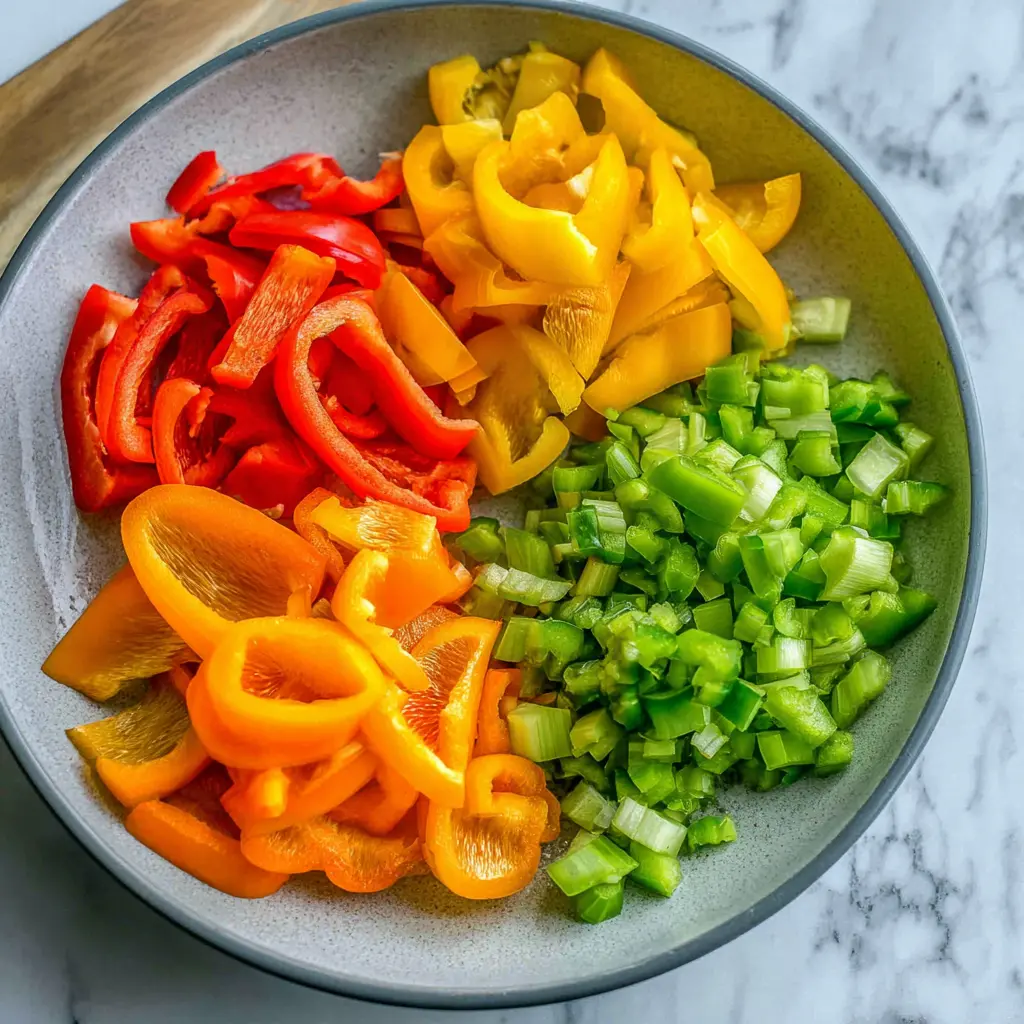
Ingredients
Method
Removing the Bell Pepper Core
- Start by placing the bell pepper horizontally on your cutting board. Carefully slice off the top, where the stem is located, and also trim the bottom end. Discard the stem if it remains connected to the top piece. Position the pepper upright, then make a single vertical cut along one side. Gently guide your knife along the interior walls, separating the core and seeds, resulting in a single, long pepper strip.
Julienning Bell Pepper
- After removing the core, orient the bell pepper strip skin-side down on your cutting surface. Carefully scrape away any pale white pith from the inner flesh. This step is crucial for achieving uniform thickness in your julienne strips.
- With the pith now removed, slice the prepped bell pepper into slender julienne strips, aiming for dimensions of approximately 1/16 inch by 1/16 inch by 1 1/2 to 2 inches (about 2mm x 2mm x 4-5cm).
Dicing Bell Pepper
- Following core removal, lay the bell pepper strip flat on your cutting board. Cut it lengthwise into robust, wider strips.
- Gather several of these strips together, then make perpendicular cuts across them to create uniform dice or small cubes of bell pepper.
Slicing Bell Pepper Rings
- Once the core is extracted, place the bell pepper horizontally. Using a very sharp knife, carefully slice thin cross-sections to form distinct, attractive bell pepper rings.
Preparing for Stuffed Bell Pepper
- For stuffing, only remove the stem end and internal core. Achieve this by carefully circling your knife around the inside perimeter of the pepper, ensuring the exterior walls remain whole and intact.
- After the core is gone, you might need to trim a small portion from the very bottom of the pepper to help it sit stably upright. Then, fill the hollowed-out bell pepper with your chosen stuffing.
Nutrition
Notes
Always use a sharp knife for clean, safe cuts; a dull knife is more dangerous.
Store pre-cut bell pepper pieces in an airtight container in the refrigerator for up to 3-5 days.
While this guide focuses on one pepper, these techniques apply to any color bell pepper; red, yellow, and orange peppers are generally sweeter than green ones.
Don't skip removing the white pith; it can be bitter and affects the texture of julienned or diced pieces.
For stuffed peppers, choose larger, wider peppers for easier filling and stability.
Julienned peppers are great for stir-fries and salads, while diced peppers are perfect for salsas, omelets, or chili. Rings are excellent for sandwiches or fajitas.
If prepping ahead for a party, you can cut peppers a day in advance to save time on busy cooking days.